

Description
Design
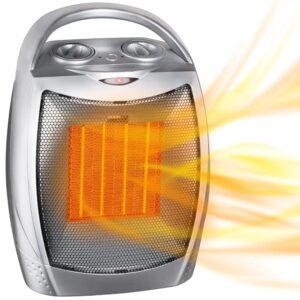
The Comfort Zone CZ798GR3 utility space heater is specified as a working tool rather than a living room appliance, and the build reflects that. All metal construction in a grey finish is the durable answer for a garage or a workshop, where a plastic bodied heater takes knocks it was never designed for. The oversized carry handle is the detail that matters most day to day, because a utility heater earns its keep by being moved to wherever the job is, not by living in one corner. A cool to touch exterior is listed, which is not a given on metal bodied units and removes a real burn risk in a tight workspace. What the design gives up is style: this is function ahead of form, and buyers furnishing a bedroom will find plenty of better looking options across the electric space heater category.
Features
The feature set is deliberately compact. Two heat settings, low and high, cover the usual range, and a fan only mode allows air to be moved without heat, which is more useful than it sounds in a workshop where solvent fumes or stale air are the problem rather than cold. The adjustable thermostat is the feature that separates this unit from the cheapest utility heaters, since it lets the heater hold a level rather than run flat out until someone switches it off, and that difference shows up on an electricity bill across a winter.
The safety hardware is the other headline. A tip over switch and an overheat protection sensor are both fitted, which is the specification to insist on in a cluttered workspace where a heater is more likely to be knocked or crowded by boxes. Power and caution indicator lights make the unit’s state readable from across a room, so there is no guessing whether it is drawing current.
Performance
Rated coverage is up to 300 square feet, which puts the CZ798GR3 in the middle of the utility tier. Owner reports on a garage of roughly 250 square feet describe a usable temperature reached on the high setting within ten to fifteen minutes, with the low setting adequate to hold it afterwards. That pattern is what the rating implies, and it is the right way to use a thermostat equipped heater: high to bring the space up, low to keep it there.
Insulation is the variable the spec sheet cannot control. In a poorly insulated garage the same wattage has to replace heat that is leaving through the walls and the door, so the unit spends more time on the high setting and the running cost climbs accordingly. For focused, targeted heating in a space of the rated size, the output is well matched.
Noise
This is a fan forced heater, so complete silence is not on offer, but the reported level is a low hum rather than the rattle some utility models produce. It reads closer to background white noise than to machinery, which keeps it usable in a home office or a study as well as in a garage. Buyers working late in a room next to sleeping family members are the group this matters to most, and on the evidence of owner feedback the unit clears that bar.
Safety
The safety case is the strongest argument for this heater over cheaper utility units. The tip over switch cuts power the moment the heater leaves vertical, which is exactly the scenario a workshop floor invites. The overheat protection sensor covers the other common failure, a unit left running for hours with restricted airflow. The cool to touch exterior completes the set, and it is the feature that makes a metal bodied heater viable in a home where children or pets share the space. None of this is exotic, but plenty of comparably priced utility heaters list one of the three rather than all of them.
Usability
There is no assembly. The heater arrives ready to plug in, and control is through dials for the thermostat and the heat setting rather than a panel or a menu. That makes it approachable for anyone put off by digital controls, and it means nothing to relearn after a summer in storage. Portability is the other usability strength, with the oversized handle and a manageable weight allowing it to move between a garage, a basement, a greenhouse and back without effort.
Maintenance
Maintenance is limited to keeping the grill clear. Dust collects on the intake of any fan forced heater, and a wipe with a damp cloth handles it. The manual also recommends periodic checks that the vents are unblocked, which is more important in a workshop than in a lounge, given the amount of airborne dust in that environment. The all metal build has no consumable parts and nothing that degrades on a schedule, so there is no service routine beyond cleaning.
Warranty
A one year warranty against manufacturer defects is included, standard for the price bracket. Owner reports mention defective units reaching buyers, and also mention that replacements were obtained without much friction under the warranty terms, which is the more useful half of that observation. Keeping the receipt is the practical step.
How to Use
Operation is a matter of plugging the unit in and turning the knobs. The sensible routine is to start on high to bring a cold space up to temperature, then drop to low and let the adjustable thermostat hold it, which uses less energy than leaving the high setting running. On milder days the fan only mode circulates air without heat, which suits a workshop where airflow rather than warmth is the requirement.
Strong Points
- Equipped with robust safety features like the tip-over switch and overheat protection.
- Compact and portable design with an oversized carry handle.
- Adjustable thermostat and multiple heat settings provide flexibility.
- Operates quietly, making it suitable for various environments.
Weaknesses
- The design leans heavily on functionality and could use a touch of modern aesthetics.
- Performance in poorly insulated spaces may require higher settings, which could increase energy usage.
Direct Competitors
Set against the Lasko ceramic tower and the Dr Infrared DR-968, this unit holds its ground on safety and portability. The Lasko runs quieter and looks more modern, but it does not carry the rugged metal build that makes a utility heater survive a workshop. The DR-968 delivers more heating capability for larger rooms, at a higher price and in a bulkier body that is less convenient to move. Within the Comfort Zone line, the CZ798BK is the direct sibling worth comparing on price, while the CZ230ER garage heater is the step up for anyone whose space runs well past 300 square feet.
Price Worthiness
For the money the specification is well judged. It is not the cheapest utility heater available, and the extra buys the thermostat, the full set of safety hardware and a metal body that should outlast a plastic one. Buyers heating a garage, a workshop, a basement or a similar space within the 300 square foot rating are the ones who get the most from it. Anyone trying to warm a much larger or badly insulated area should size up rather than push this unit past what it was rated for.