

Description
Maintenance
Upkeep on the RANVOO XN 1 space heater is straightforward, which matters on a unit likely to run daily through a winter. The dust filter is the feature that separates it from most compact heaters: it removes and rinses in seconds, and having a filter at all means the element is not drawing household dust straight past it. That is a genuine benefit in a bedroom, where dust accumulation is highest and where a filterless heater eventually pushes those particles back into the air. The graphene heating element cools quickly after switch off, which makes the unit safe to handle for cleaning sooner than a ceramic design. The white exterior does show smudges, so a microfiber cloth is worth keeping nearby.
Noise
The published noise level is below 30 decibels, which is at the very quiet end of this category and below the threshold most people register at all. In practical terms that means the unit stays clear of video calls, focused work and film audio. The bladeless design is the reason: with no conventional fan blade chopping the airflow, the dominant noise source on most heaters is removed. It is not absolutely silent, and a faint operational sound is detectable in a completely quiet room, but for anyone sensitive to appliance noise this is one of the better options available. For another compact quiet unit, see the Gaiatop SH02 mini heater.
Features
The feature set is unusually advanced for a heater this size. Warm up is stated at roughly one second, which graphene makes plausible in a way it would not be for a wire element, and the material delivers consistent output rather than the surging characteristic of cheaper designs. The 120° adjustable head is the most practically useful feature, allowing output to be angled up toward hands at desk level or down toward feet beneath it. An energy efficient mode is rated at under 3 kWh overnight, which is a meaningful figure for anyone running a heater through the night. Tip over protection cuts power the moment the unit is displaced.
Safety
Safety specification is a clear strength. The overheat protection system uses IC monitoring rather than a simple bimetallic cutout, which means the temperature is tracked continuously rather than only at a trip threshold. The 45° tilt sensor is the other notable specification: it responds to partial displacement rather than waiting for the unit to fall flat, which matters on a light body that a child or pet can nudge. The graphene material is also specified as inhibiting bacterial growth on the element surface, which is a secondary benefit on a unit that moves air through a filter.
Usability
Operation is deliberately simple. A single knob covers three modes: a fan for summer use and two heat settings at 800W and 1000W. That lower ceiling is a deliberate design decision, keeping draw low enough for the unit to share a circuit with a desk setup. Switching modes is a single motion. The one ergonomic complaint is the knob itself, which can be difficult to turn with damp hands or after applying hand lotion. The low weight makes moving it between rooms trivial, and under desk placement is where the design works best.
Design
The minimalist styling is genuinely well executed. The white body with rose gold accents reads as a designed object rather than an appliance, and at just over 2 pounds it sits comfortably on a nightstand or a desk without dominating either. The adjustable head is the functional part of that design, giving flexibility in aiming heat that fixed units cannot match. The omission worth flagging is a carry handle: without one, moving the unit means gripping the body, which is less convenient than it should be on a product designed for portability.
Performance
Output tracks the rating honestly. Graphene heating delivers quick, even distribution, and a small bedroom of roughly 10 by 12 feet reaches a comfortable level in under ten minutes. In a larger living room the effect is noticeable but the unit is clearly working beyond its intended range, which is unsurprising at a 1000W ceiling. Energy efficiency is the standout: running overnight adds very little to an electricity bill compared with a 1500W element. The honest framing is that this heater is better at maintaining warmth than at heating a cold room from scratch.
Pros
Key Benefits
- Rapid heat up time with graphene technology.
- Adjustable 120° head for targeted heating.
- Lightweight and portable design.
- Strong safety features, including tip over and overheat protection.
Cons
Areas for Improvement
- Knob can be slippery to turn with damp or greasy hands.
- Slightly underpowered for heating larger rooms.
- Lack of a carrying handle for easier portability.
Other Options
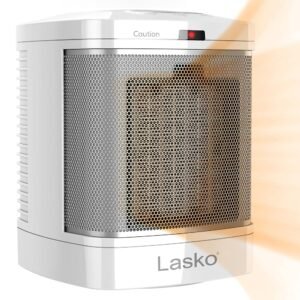
Against established names in the electric space heater category, this unit separates itself on graphene heating and design rather than on raw output. Lasko models frequently add oscillation and higher wattage, at the cost of bulk and consumption. Honeywell units such as the Honeywell UberHeat have a strong durability record but a plainer design and a higher noise floor. For buyers ranking safety and minimalist styling first, this unit is the stronger pick; for larger rooms, a higher wattage model such as the Dr Prepare DCH03 is the better route.
Bang for the Buck
For its size and specification this heater offers solid value. The energy efficiency alone makes a real difference over a season of daily use, since a 1000W ceiling costs meaningfully less to run than the 1500W elements that dominate the category. It is not the cheapest option available, but the safety hardware and the warm up speed justify the difference. It is a sound choice for small to medium spaces and for personal heating in particular. Buyers wanting the smallest possible footprint should also see the Lasko MyHeat 100.